
Skip to content

Foundation repair service · Alabama

Foundation Pier Installation in Alabama

Push piers, helical piers, and concrete piers: how each works, why pier depth varies so much across Alabama, and what piering costs.

Free referral to a participating independent contractor. No obligation.

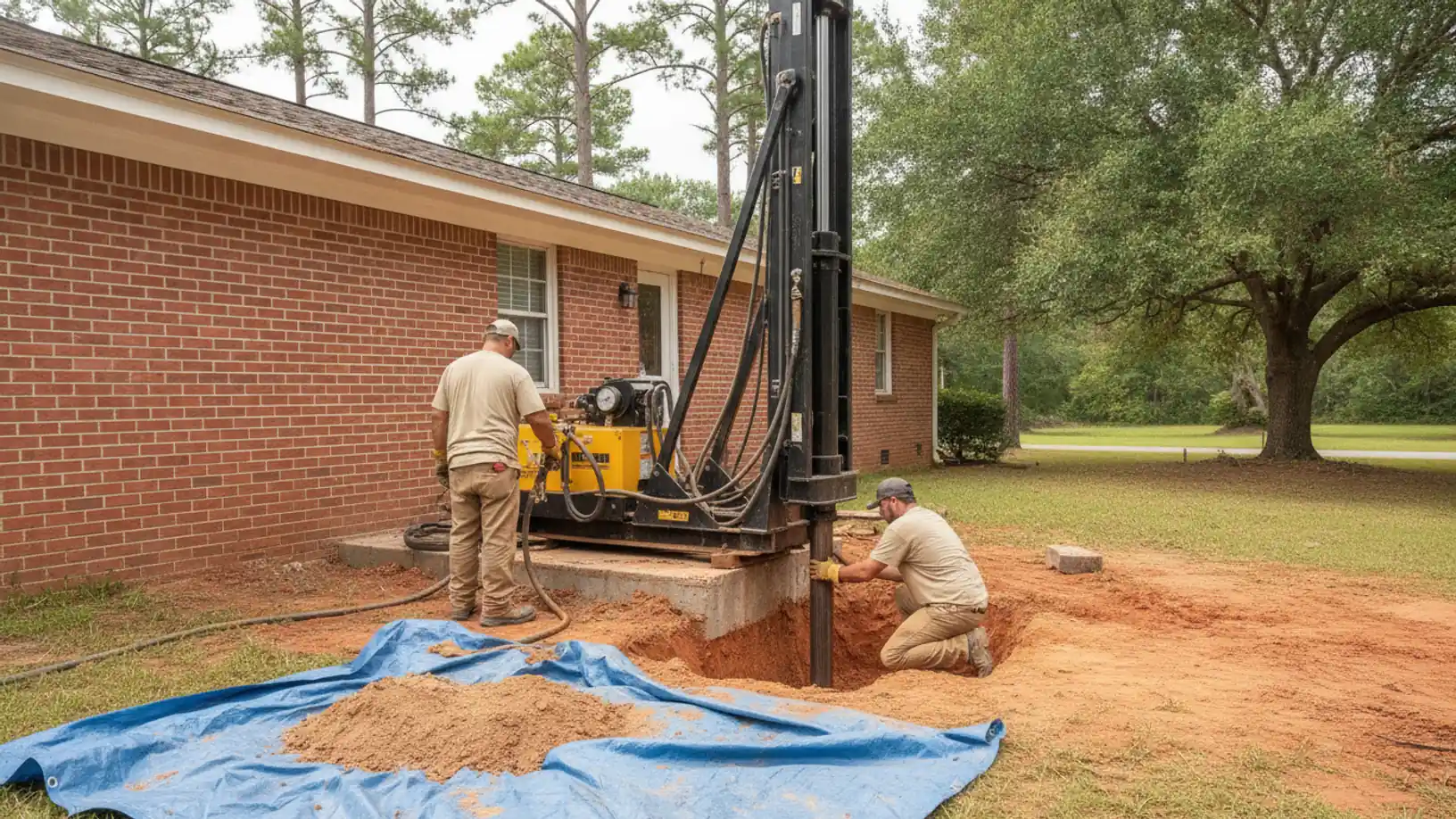
Hydraulic driving equipment pressing a steel push pier beside an excavated footing of a brick house
Fig. 1Illustrative photo. Hydraulic driving equipment pressing a steel push pier beside an excavated footing of a brick house.

Last updated: 2026-10-12

Alabama Foundation Repair connects Alabama homeowners with participating contractors for foundation pier installation, also called underpinning. Piers carry the weight of a settling section of foundation down past weak or moving soil to something that will hold it. They are the most common permanent-intent repair for settlement, and also the most expensive part of most foundation jobs, so it pays to understand what you are being sold.

Types of foundation piers

Contractors in Alabama use several systems. Each has a place:

  • Steel push piers (resistance piers): sections of steel tube driven hydraulically, using the house's own weight as the counterforce, until they hit rock or a soil layer that resists the load. A bracket then ties the footing to the pier. Common on heavier houses with settling footings.
  • Helical piers: steel shafts with helix plates screwed into the ground. Installers track torque as they go, which correlates with load capacity. Useful for lighter structures, porches, and where there is not enough house weight to drive a push pier.
  • Concrete pressed piers: short concrete cylinders pressed down one on top of another. Less expensive; depth is usually limited compared with steel.
  • Poured concrete piers: holes drilled and filled with reinforced concrete, sometimes belled at the bottom. Used in some regions and on new construction.

Why pier depth varies so much in Alabama

Piers stop where they find enough resistance, and that changes across the state. In north Alabama's limestone valleys, rock can be shallow in one spot and far deeper a few feet away, because the rock surface in karst is uneven. In the Coastal Plain around Mobile and Montgomery, there may be no shallow rock at all, so piers rely on dense sand or clay layers. Fill and old wetland soils can push depths further.

That is why a proposal should say how depth and load will be verified, and what happens if a pier goes much deeper than expected. Some contractors price extra depth per foot; others include it.

How many piers a house needs

Only the section that is settling gets piers, plus enough on either side to carry the load. Spacing commonly runs every few feet along the affected footing, depending on the house's weight, the pier system, and the soil. A corner may need four to six; a whole side can need many more. Ask for a drawing that shows every pier location.

What installation looks like

For exterior piers, the crew digs small pits beside the footing at each location, attaches a bracket, drives or screws the pier to depth, and transfers the load. Lifting, if any, is done slowly across several piers at once. Interior piers under a slab mean cutting holes through the floor. The pits are backfilled; landscaping, flatwork, and interior finishes may be extra. Never try to lift or underpin a house yourself; the loads involved are dangerous.

When piers may be on the table

  • A corner or side of the house is visibly lower than the rest.
  • Settlement cracks have come back after cosmetic repair.
  • An inspection or engineer report recommends underpinning.
  • A porch, chimney, or addition is pulling away and sinking.
  • Floors keep sloping further over months, not years.

These are reasons to get the house looked at, not a diagnosis. Some have harmless causes.

What foundation piers cost

HomeAdvisor's June 2026 data puts piering and underpinning at $1,000 to $3,000 per pier. A settling-foundation repair overall runs $5,000 to $25,000. Since even a modest pier job often passes $10,000, Alabama law requires the contractor to hold a Home Builders Licensure Board license for it.

  • Number of piers and their spacing.
  • Pier type: steel push, helical, or concrete.
  • Depth to rock or load-bearing soil, and how extra depth is priced.
  • Interior vs. exterior piers (interior means cutting the slab).
  • Lifting, engineering, permits, and restoration of landscaping and flatwork.

Source: HomeAdvisor cost data, updated June 2026. National ranges, not quotes. Comparing quotes? Try the quote comparison tool.
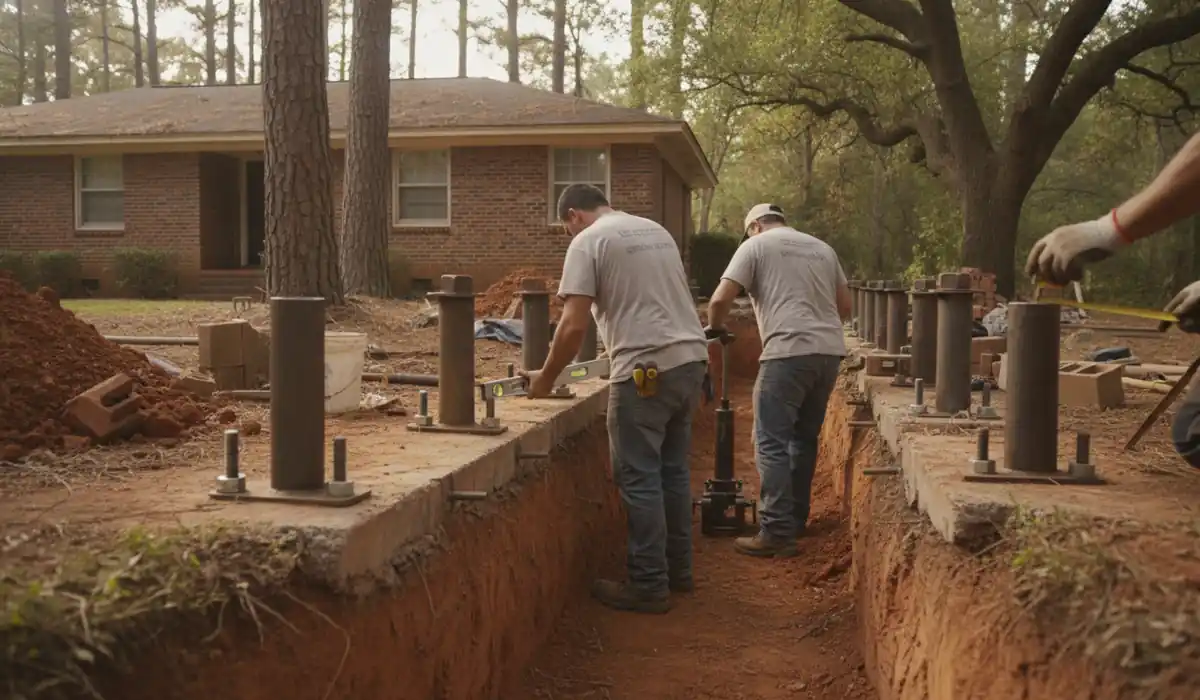
Row of steel pier brackets bolted along an exposed concrete footing in a narrow excavation
Fig. 2Illustrative photo. Row of steel pier brackets bolted along an exposed concrete footing in a narrow excavation.

Piers and engineers

Many pier manufacturers publish engineering data for their systems, but that is not the same as an engineer looking at your house. For large jobs, sinkhole areas, old mine ground around Birmingham, or a house being sold, ask whether an independent licensed engineer should specify the pier layout. See when to hire a structural engineer.

Before you sign a pier proposal

  1. Get a drawing with every pier location marked.
  2. Get the pier type, size, target depth or load, and how it will be verified.
  3. Ask how extra depth is priced.
  4. Get two proposals on a large job and compare them line by line.
  5. Check the HBLB license if the job is over $10,000.

Questions to ask about piers

  • Push, helical, or concrete, and why that type for my house?
  • How many piers, where, and at what spacing?
  • What depth or load do you expect, and how will you prove you reached it?
  • What happens to the price if a pier goes deeper?
  • Will you lift, and how much?
  • What does the warranty cover, and does it transfer?

Related foundation repair guides

Straight answers

What you can do now vs. when to get a professional evaluation

Watching, measuring, and fixing drainage are jobs for a homeowner. Diagnosing the cause and repairing structure are not.

What you are seeingWhat you can do nowWhen to get a professional evaluation
A thin crack in a slab or poured wallPhotograph it beside a ruler, mark the ends in pencil with the date, and recheck after a dry spell and after heavy rainIt widens, one side sits higher, or water comes through
Stair-step cracks in brick or blockPhotograph and date them; note any doors or windows nearby that stickThey are growing, or bricks or blocks have shifted out of line
Floors sloping or bouncing over a crawl spaceFrom the access opening, look with a flashlight for standing water, leaning piers, or soft woodIt is getting worse, or supports look cracked, sunken, or rotted
Cracks that open in summer and close in winterKeep gutters and grading sending water away; date photos across seasonsThey get wider each year, or one area keeps dropping
A basement or retaining wall leaning inwardKeep the area clear; do not try to push or brace it yourselfAlways: horizontal cracks and inward lean are a structural question
A depression or hole near the houseKeep people and pets away; on public land or a road, report it to local officialsAlways. Call 911 if a building is moving or anyone is in danger

General guidance, not a diagnosis. For sinkholes, the Geological Survey of Alabamaadvises securing the area, contacting your insurer, and hiring a geologist or engineer. Never jack, cut, or remove a structural support yourself.

The process

How a pier job usually runs

Every house and every foundation problem is different. These are the stages most projects follow.

  1. An on-site evaluation

    The contractor looks at cracks, floors, doors, the crawl space or slab, and the drainage around the house, and may measure how far floors are out of level. Symptoms alone do not tell anyone the cause; the visit is where that starts.

  2. A written plan and price

    Ask for the proposed repair, why it fits the cause they found, the number and location of any piers or supports, any permit, and the price in writing. In Alabama, a residential job over $10,000 needs a Home Builders Licensure Board license and a written contract.

  3. An engineer, when the situation calls for one

    For large movement, a sinkhole, possible mine ground, a home sale, or contractors who disagree, an independent licensed structural engineer can assess the cause and specify the repair. Contractors are not engineers unless they are licensed as one.

  4. The repair

    Depending on the cause: piers or underpinning, slab lifting, crack injection or masonry repair, crawl space supports, or drainage changes. Ask how long it will take and what access the crew needs.

  5. Warranty and paperwork

    Get the warranty in writing: what it covers, for how long, and whether it transfers to a buyer. Keep the plan, invoice, permit, and any engineer report together; buyers and inspectors ask for them.

How it works

How our contractor-matching service works

(205) 859-3946
  1. You call the number on this site

    Have the property address or ZIP code ready, and describe what you are seeing: cracks, sloping floors, sticking doors, a leaning wall, and how long it has been going on.

  2. Your call is routed to a participating contractor

    Your call is connected with a participating independent foundation repair contractor who serves your area, if one is available. We do not inspect anything or send anyone ourselves.

  3. You deal with that contractor directly

    The contractor evaluates the house, recommends a repair, quotes the price, and does any work you agree to under their own business name, license, insurance, and warranty. You decide whether to hire them. There is no obligation.

Good to know: availability and eligible services depend on which participating contractors cover your ZIP code. Whoever you hire, ask for their Alabama Home Builders Licensure Board license number on any job over $10,000, and check it at hblb.alabama.gov.

Questions

Foundation Pier Installation: common questions

How much does a foundation pier cost in Alabama?

HomeAdvisor's June 2026 national data puts piering at $1,000 to $3,000 per pier. Total cost depends on how many piers the plan calls for, the system used, how deep they go, and whether the house is lifted.

Push piers or helical piers: which is better?

Neither is better everywhere. Push piers use the house's weight to drive to rock or dense soil and suit heavier houses. Helical piers are screwed in with measured torque and suit lighter loads and situations without enough weight to drive a push pier. The soil and the structure decide.

How deep do foundation piers go?

As deep as needed to reach rock or soil that holds the load, which varies widely in Alabama, from a few feet in some limestone areas to dozens of feet in deep soils or fill. A good proposal says how depth and load are verified.

Is underpinning the same as piering?

Mostly. Underpinning means extending a foundation's support deeper. Steel and concrete piers are the most common way to do it on houses today, so the terms are often used interchangeably.

Talk to a Contractor About Foundation Piers

Call and we will try to connect you with a participating independent foundation repair contractor who serves your part of Alabama. No obligation to hire.

Call (205) 859-3946

Free referral. Availability varies by ZIP code.

Call (205) 859-3946 · Foundation Repair Help