
Skip to content

Foundation repair service · Alabama

Slab Foundation Repair in Alabama

Slab-on-grade houses are the norm across much of Alabama. Why slabs crack, sink, and heave on clay and fill, and how each problem is repaired.

Free referral to a participating independent contractor. No obligation.

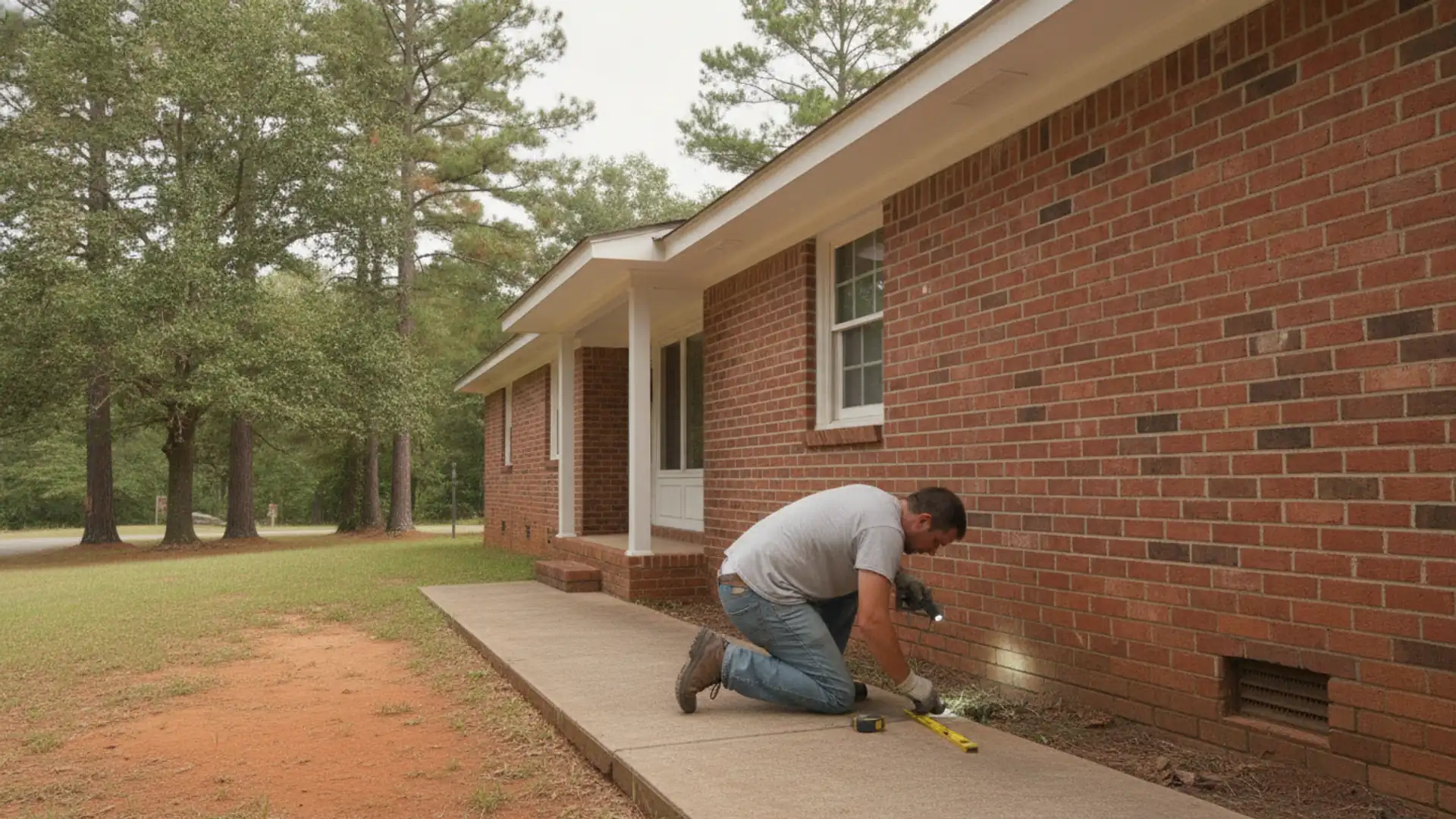
Single-story brick slab-on-grade house in Alabama with a cracked concrete walkway along the front
Fig. 1Illustrative photo. Single-story brick slab-on-grade house in Alabama with a cracked concrete walkway along the front.

Last updated: 2026-10-12

Alabama Foundation Repair connects Alabama homeowners with participating contractors for slab foundation repair. A slab-on-grade foundation is a concrete floor poured directly on the ground, usually with thickened edges as footings. It is the standard foundation in much of Alabama, especially in the Coastal Plain and Black Belt and in most houses built since the 1970s. Because the slab sits right on the soil, it moves when the soil does.

Why slabs move on Alabama soils

A slab can sink, heave, or crack depending on what the soil underneath is doing:

  • Shrink-swell clay: in the Black Belt and other clay areas, soil swells in wet winters and shrinks in dry summers. The edges of a slab dry out faster than the middle, so slabs can rise in the center and drop at the edges, or the reverse.
  • Settling fill: builders often bring in fill to level a lot or raise a slab. Poorly compacted fill keeps settling, and an uneven fill depth means uneven settling.
  • Water at the edges: downspouts and poor grading soak and soften the soil under the perimeter beam, or wash it away.
  • Plumbing leaks under the slab: a leaking supply or drain line can soften or wash out soil from below. A plumber's leak test is a sensible first step when slab movement appears suddenly.
  • Tree roots: large trees near the slab draw water out of clay in summer.

Signs of slab foundation problems

Many slab cracks are harmless shrinkage. These are the patterns more often linked to movement:

  • Cracks in tile floors or a slab crack with one side higher than the other.
  • Floors that slope toward an outside wall, or a hump in the middle of the house.
  • Stair-step cracks in brick veneer, especially at corners.
  • Interior doors that drag or will not latch.
  • Gaps at baseboards or between cabinets and walls.

Slab repair methods

The method depends on whether the slab is sinking, heaving, or just cracked:

  • Polyurethane foam lifting: small holes are drilled and expanding foam is injected to lift the slab and fill voids. Light, quick to cure, and suited to shallow settlement.
  • Mudjacking (slabjacking): a cement grout pumped under the slab. Similar idea, heavier material, larger holes.
  • Perimeter piers: steel or concrete piers along a settling edge beam, carrying it to deeper support. See foundation pier installation.
  • Interior piers: placed through cut openings in the slab where the interior is settling.
  • Moisture control: drainage, gutters, and in some cases root barriers to keep soil moisture more even under the slab. Heave from swelling clay is usually managed this way rather than with piers.

Heave is not the same as settlement

If the middle of a slab has risen rather than the edges having sunk, piers will not push it back down. Heave from swelling clay or a water leak needs the moisture source found and managed. This is one of the most common places for a wrong repair, so ask the contractor to say plainly whether they see settlement or heave, and how they measured it.

When slab movement needs a professional look

  • A slab crack has one side higher than the other or keeps widening.
  • Floors slope noticeably toward one wall, or rise in the middle.
  • New cracks in tile, brick, and drywall show up together.
  • Movement appeared suddenly, especially with a higher water bill.
  • Doors that used to close fine now drag or will not latch.

These are reasons to get the house looked at, not a diagnosis. Some have harmless causes.

What slab foundation repair costs

HomeAdvisor's June 2026 data puts slabjacking or mudjacking at $500 to $1,300, crack sealing at $250 to $800, piers at $1,000 to $3,000 each, and repairs for a settling or sinking foundation at $5,000 to $25,000. A plumbing leak repair under the slab is a separate cost from a plumber.

  • Lift vs. piers: foam or grout lifting costs far less than piering an edge beam.
  • How much of the slab is affected.
  • Interior work: flooring removal and replacement over interior piers or injection holes.
  • Leak detection and plumbing repair if a leak is involved.

Source: HomeAdvisor cost data, updated June 2026. National ranges, not quotes. Comparing quotes? Try the quote comparison tool.
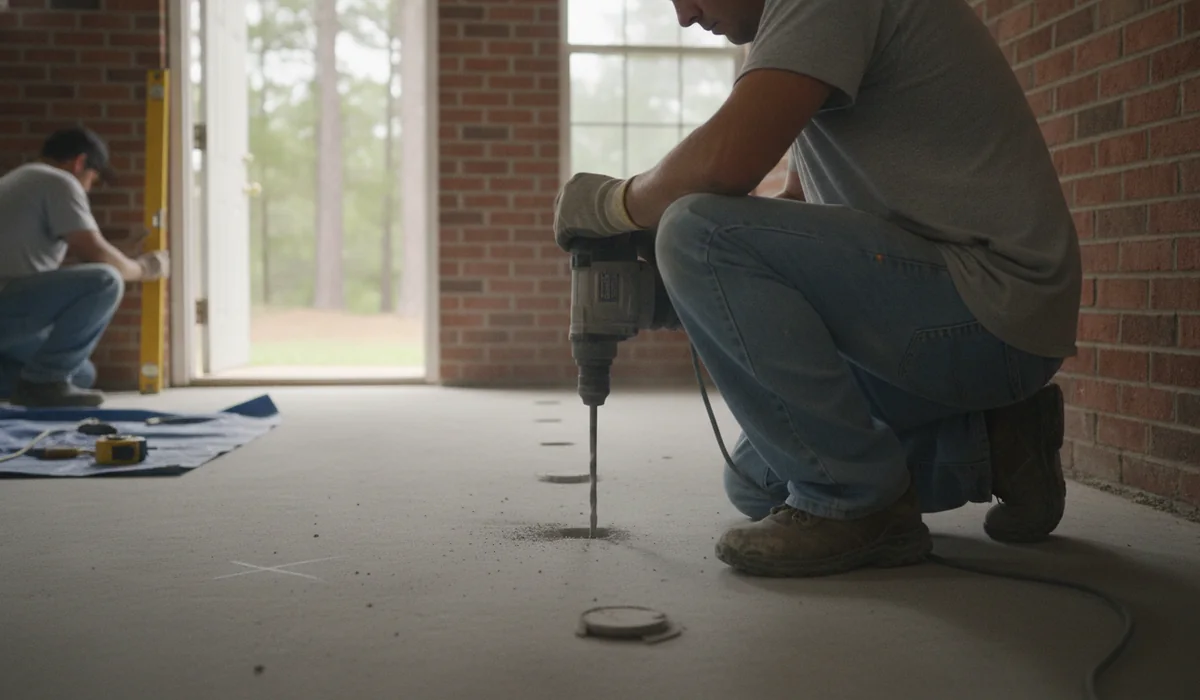
Crew member drilling small injection holes in a concrete slab floor for polyurethane foam lifting
Fig. 2Illustrative photo. Crew member drilling small injection holes in a concrete slab floor for polyurethane foam lifting.

When a slab problem calls for an engineer

An independent structural engineer is worth it when it is not clear whether a slab is settling or heaving, when movement continues after a repair, or when a buyer, seller, or lender wants a report. HomeAdvisor puts an inspection at $340 to $780. See when to hire a structural engineer.

What you can do right now

  1. Check your water bill for an unexplained jump, and ask a plumber about a slab leak test if one appears.
  2. Make sure downspouts discharge well away from the slab edge.
  3. Photograph cracks in tile, brick, and drywall, and date them.
  4. Note which doors stick and when, and whether it changes between wet and dry seasons.
  5. Call and describe the house: slab age, what you see, and when it started.

Questions to ask about slab repair

  • Is this settlement or heave, and how did you measure it?
  • Foam, grout, or piers, and why?
  • Should a plumber test for a leak before you start?
  • How much lift do you expect, and what might crack inside when you lift?
  • What flooring or finish work is included?
  • If the job is over $10,000, is your company HBLB-licensed?

Related foundation repair guides

Straight answers

What you can do now vs. when to get a professional evaluation

Watching, measuring, and fixing drainage are jobs for a homeowner. Diagnosing the cause and repairing structure are not.

What you are seeingWhat you can do nowWhen to get a professional evaluation
A thin crack in a slab or poured wallPhotograph it beside a ruler, mark the ends in pencil with the date, and recheck after a dry spell and after heavy rainIt widens, one side sits higher, or water comes through
Stair-step cracks in brick or blockPhotograph and date them; note any doors or windows nearby that stickThey are growing, or bricks or blocks have shifted out of line
Floors sloping or bouncing over a crawl spaceFrom the access opening, look with a flashlight for standing water, leaning piers, or soft woodIt is getting worse, or supports look cracked, sunken, or rotted
Cracks that open in summer and close in winterKeep gutters and grading sending water away; date photos across seasonsThey get wider each year, or one area keeps dropping
A basement or retaining wall leaning inwardKeep the area clear; do not try to push or brace it yourselfAlways: horizontal cracks and inward lean are a structural question
A depression or hole near the houseKeep people and pets away; on public land or a road, report it to local officialsAlways. Call 911 if a building is moving or anyone is in danger

General guidance, not a diagnosis. For sinkholes, the Geological Survey of Alabamaadvises securing the area, contacting your insurer, and hiring a geologist or engineer. Never jack, cut, or remove a structural support yourself.

The process

What slab repair usually involves

Every house and every foundation problem is different. These are the stages most projects follow.

  1. An on-site evaluation

    The contractor looks at cracks, floors, doors, the crawl space or slab, and the drainage around the house, and may measure how far floors are out of level. Symptoms alone do not tell anyone the cause; the visit is where that starts.

  2. A written plan and price

    Ask for the proposed repair, why it fits the cause they found, the number and location of any piers or supports, any permit, and the price in writing. In Alabama, a residential job over $10,000 needs a Home Builders Licensure Board license and a written contract.

  3. An engineer, when the situation calls for one

    For large movement, a sinkhole, possible mine ground, a home sale, or contractors who disagree, an independent licensed structural engineer can assess the cause and specify the repair. Contractors are not engineers unless they are licensed as one.

  4. The repair

    Depending on the cause: piers or underpinning, slab lifting, crack injection or masonry repair, crawl space supports, or drainage changes. Ask how long it will take and what access the crew needs.

  5. Warranty and paperwork

    Get the warranty in writing: what it covers, for how long, and whether it transfers to a buyer. Keep the plan, invoice, permit, and any engineer report together; buyers and inspectors ask for them.

How it works

How our contractor-matching service works

(205) 859-3946
  1. You call the number on this site

    Have the property address or ZIP code ready, and describe what you are seeing: cracks, sloping floors, sticking doors, a leaning wall, and how long it has been going on.

  2. Your call is routed to a participating contractor

    Your call is connected with a participating independent foundation repair contractor who serves your area, if one is available. We do not inspect anything or send anyone ourselves.

  3. You deal with that contractor directly

    The contractor evaluates the house, recommends a repair, quotes the price, and does any work you agree to under their own business name, license, insurance, and warranty. You decide whether to hire them. There is no obligation.

Good to know: availability and eligible services depend on which participating contractors cover your ZIP code. Whoever you hire, ask for their Alabama Home Builders Licensure Board license number on any job over $10,000, and check it at hblb.alabama.gov.

Questions

Slab Foundation Repair: common questions

How do you fix a sinking slab foundation?

Shallow settlement can often be lifted with polyurethane foam or cement grout pumped under the slab. Settlement from deeper soft soil or fill usually needs piers along the affected edge or through the floor. If a leak or drainage problem caused it, that is fixed first.

How much does slab foundation repair cost in Alabama?

HomeAdvisor's June 2026 data puts slabjacking at $500 to $1,300, crack sealing at $250 to $800, piers at $1,000 to $3,000 each, and larger settlement repairs at $5,000 to $25,000. Lifting costs far less than piering.

Are cracks in a concrete slab normal?

Thin, random cracks are common as concrete shrinks while curing, and they are usually cosmetic. Cracks with one side higher than the other, cracks that keep widening, or cracks that appear with sloping floors and sticking doors suggest movement.

Can a plumbing leak damage a slab foundation?

Yes. A leaking line under a slab can soften or wash out the soil beneath it, causing settlement, or swell clay and cause heave. If slab movement appears suddenly, a plumber's leak test is a sensible first step.

Get Help With a Slab Foundation

Call and we will try to connect you with a participating independent foundation repair contractor who serves your part of Alabama. No obligation to hire.

Call (205) 859-3946

Free referral. Availability varies by ZIP code.

Call (205) 859-3946 · Foundation Repair Help