
What causes foundation settlement? Settlement happens when the soil under part of a foundation compresses, shrinks, or washes away, so that section sinks lower than the rest. In Alabama, the usual causes are shrink-swell clay, poorly compacted fill, water at the foundation, large trees near the house, and, in north Alabama, voids in limestone. Several often act together, and only an on-site evaluation can say which ones apply to a particular house.
1. Clay that shrinks and swells
Clay soils change volume with moisture. They swell when wet and shrink when dry, and the most active clays move a lot. The Black Belt, the band of dark prairie soils that arcs across central Alabama around Montgomery, contains a considerable amount of montmorillonite clay that shrinks and swells as soil moisture changes, according to Auburn University. Clay soils elsewhere in the state behave similarly, if less dramatically.
Alabama’s weather drives this cycle. Its major cities average about 51 to 67 inches of rain a year (NOAA 1991-2020 normals), with wet winters and springs and hot, dry stretches in late summer. The edge of a slab dries out faster than the middle, so slabs on clay tend to drop at the edges in dry spells. When the soil wets up, some of that movement reverses, which is why cracks in clay country often open in summer and close in winter.
Clay can also heave: lift part of a slab when it swells. Heave and settlement can look alike, but they need different repairs, so it matters which one you have. See slab foundation repair.
2. Fill that was not compacted
Builders often bring in fill to level a sloped lot or raise a building site. Well-compacted fill behaves. Loose fill keeps compressing for years, and uneven fill depth under one house means uneven settlement. This is common in hillside subdivisions around Birmingham and on low ground that was raised for building around Mobile.
3. Water at the foundation
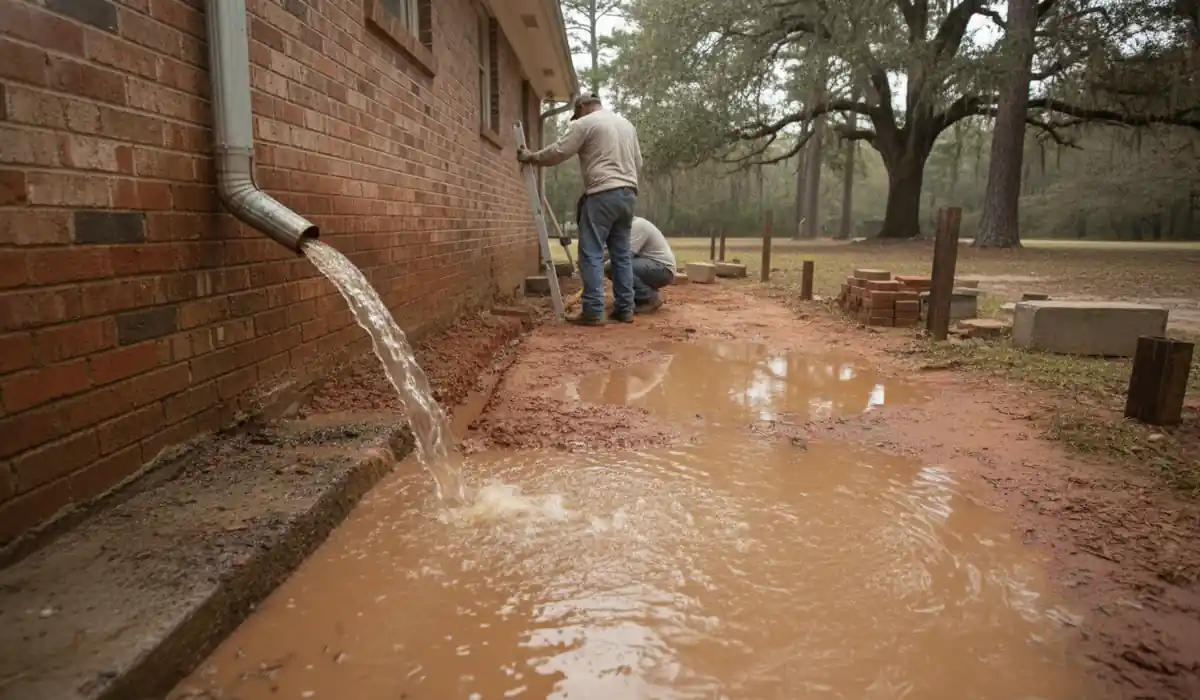
Water is the most common accelerator. A downspout dumping roof water at a corner, a yard graded toward the house, or a leaking pipe under a slab can soften soil under a footing or wash it away. Saturated soil also loses strength, which is one reason cracks often show up after a very wet season or a tropical storm. Fixing drainage is cheap compared with piers, and it is part of almost every lasting repair.
4. Trees near the house
Large trees pull a surprising amount of water out of the soil in summer. Close to a house on clay, they can dry out the soil under one corner and drop it. Removing a big tree can cause the opposite: the soil slowly rewets and swells. Either way, talk to a contractor before cutting.
5. Limestone, voids, and sinkholes
Carbonate rock, mainly limestone and dolomite, underlies about a quarter of Alabama, mostly in the northern half of the state, according to the U.S. Geological Survey. Groundwater slowly dissolves this rock, leaving voids that soil can drain into. The Geological Survey of Alabama lists the triggers that can set off a collapse: a falling water table from drought or well pumping, heavy construction, drainage problems, abandoned mines, and excessive rainfall. In Shelby County’s Dry Valley it documents hundreds of historical collapses in about 16 square miles, including the 1972 “Golly Hole” near Calera.
Most foundation settlement in Alabama is not a sinkhole. But if a depression or hole opens near the house, keep people and pets away, contact your insurer, and get a geologist or engineer involved before any repair. Alabama does not require insurers to include sinkhole coverage; they may offer it, per the synopsis of Senate Bill 326, a 2024 bill that did not pass.
6. Old mine workings
Around Birmingham, the red iron ore district ran along Red Mountain, and engineers documented surface fracturing and subsidence over old workings in the early twentieth century. This affects only some properties, but where it is possible it is a strong reason to involve an independent engineer.
How to tell which cause you have
You usually cannot tell from the inside of the house. Clues that help a contractor or engineer:
- When it moves: seasonal opening and closing points toward clay; sudden movement toward water, a leak, or a void.
- Where it moves: corners near downspouts or trees, the downhill side of a sloped lot, or the middle of a slab.
- Direction: sinking edges versus a rising middle (settlement versus heave).
- History: recent drought, heavy rain, a removed tree, new construction nearby, or a plumbing leak.
Dated photos of cracks across a few seasons are one of the most useful things you can bring to an evaluation.
What happens next
Settlement from shallow causes can often be fixed with drainage, moisture control, or slab lifting. Settlement from deep soft soil, fill, or voids usually needs foundation piers to carry the load to firmer ground. See foundation settlement repair for the options and the Alabama cost guide for typical prices.
The bottom line
If you want a professional to take a look, call (205) 859-3946 and we'll try to connect you with a participating independent foundation repair contractor who serves your area. That contractor evaluates and quotes the job themselves. In the meantime, don't jack, cut, or remove any structural support, and if the ground or the house is actively moving, get everyone out and call 911.