
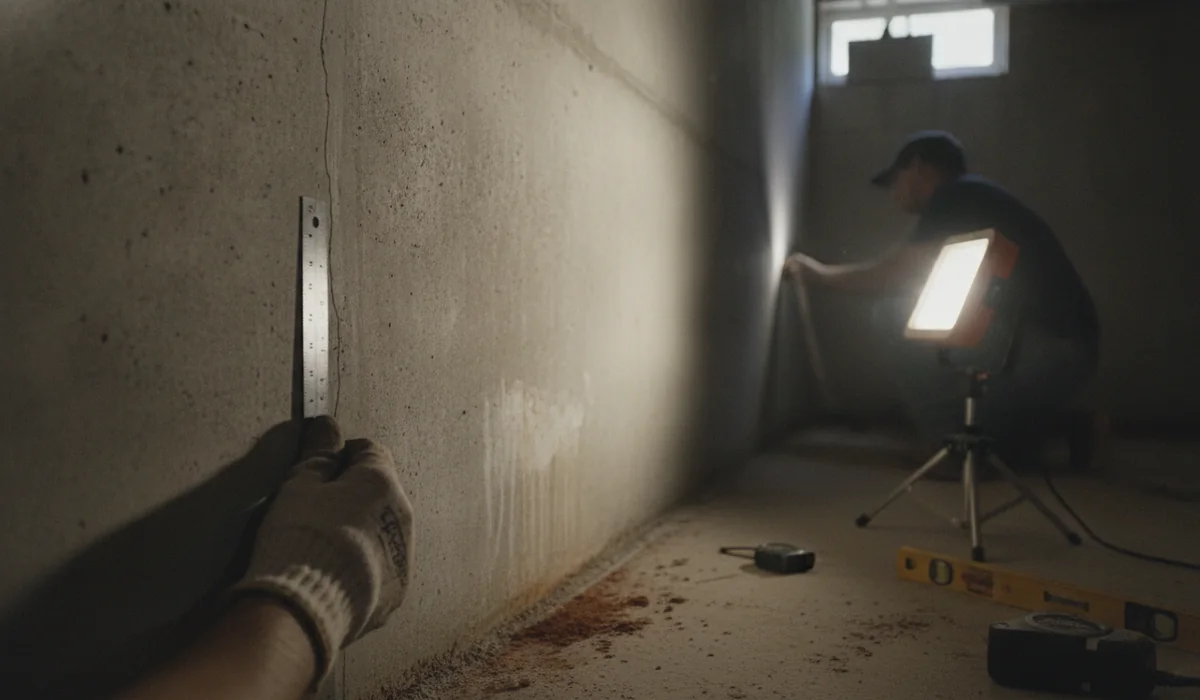
Horizontal vs. vertical foundation cracks: vertical cracks in poured concrete are usually shrinkage from curing and are often minor if they stay thin and dry. Horizontal cracks, especially in block basement or retaining walls, usually mean soil is pushing the wall inward and should be evaluated promptly. Diagonal and stair-step cracks often point to settlement. In every case, how wide a crack is and whether it is growing matter more than how long it is.
These are patterns, not diagnoses. A contractor or engineer reads them together with floors, doors, drainage, and the soil before saying what is going on.
Vertical cracks
A vertical crack runs straight up and down, or close to it.
- In poured concrete walls: very common. Concrete shrinks as it cures, and that shrinkage has to go somewhere. Thin, dry, stable vertical cracks are usually cosmetic.
- When to pay attention: the crack widens, is wider at the top or bottom, lets water through, or has one side sitting out of line with the other.
- Common repair: if it leaks, polyurethane injection; if strength across it matters, epoxy. See foundation crack repair.
Horizontal cracks
A horizontal crack runs sideways along a wall, often partway up a basement or retaining wall.
- What it usually means: soil on the outside pushing the wall inward. Wet, swelling clay pushes hardest, and block walls are more vulnerable than poured walls.
- What often comes with it: the wall bowing or leaning inward, or blocks shifting out of line along the crack.
- Why it matters: this is the pattern most likely to keep getting worse. Do not try to brace or push the wall yourself.
- Common repairs: wall anchors, steel braces, or carbon fiber reinforcement, sometimes excavation and rebuilding, plus drainage on the outside.
In Alabama, basements are most common on the sloped lots around Birmingham, Gadsden, and north Alabama, so that is where horizontal basement-wall cracks come up most.
Diagonal cracks
A diagonal crack runs at an angle, often from the corner of a window or door, or from the top corner of a wall.
- What it usually means: one part of the foundation settling more than another. The crack often points up toward the side that dropped.
- Common repair: fixing the settlement, often with foundation piers, then repairing the crack.
Stair-step cracks in brick and block
A stair-step crack follows the mortar joints in a zigzag. Because most Alabama houses have brick veneer, this is often the first crack people notice.
- What it usually means: settlement under that wall, or, in a block basement wall, soil pressure. In brick veneer it can also come from a sagging steel lintel over a window or from thermal movement.
- When to pay attention: the crack is widening, bricks have shifted out of line, or it appeared with sticking doors and sloping floors.
Slab cracks
Cracks in a concrete slab floor are extremely common.
- Usually minor: thin, random cracks from shrinkage, often found under carpet or showing through vinyl.
- More concerning: one side higher than the other, cracks that keep widening, or a line of cracks running across a room with tile cracking above it. On clay soils like Montgomery’s, the slab may be heaving (rising) rather than settling, and the repair is different. See slab foundation repair.
How to monitor a crack
- Mark both ends with a pencil and write the date beside each mark.
- Photograph it with a ruler or coin for scale, from the same spot each time.
- Check again after a few months, after a long dry spell, and after heavy rain.
- Note any doors or windows nearby that start to stick.
- Do not fill or paint over it until a contractor sees it.
When to get a crack looked at
- Any horizontal crack in a basement or retaining wall.
- Any crack wider than about a quarter inch, or wider at one end.
- Any crack with one side offset or out of plane.
- Any crack that has grown since you marked it.
- Cracks that appear together with sloping floors or sticking doors.
If the pattern is unclear or two contractors disagree, an independent engineer can help; see when to hire a structural engineer. For what repairs cost, see the Alabama foundation repair cost guide.
The bottom line
If you want a professional to take a look, call (205) 859-3946 and we'll try to connect you with a participating independent foundation repair contractor who serves your area. That contractor evaluates and quotes the job themselves. In the meantime, don't jack, cut, or remove any structural support, and if the ground or the house is actively moving, get everyone out and call 911.